
Source: Prime Minister’s Office of Japan
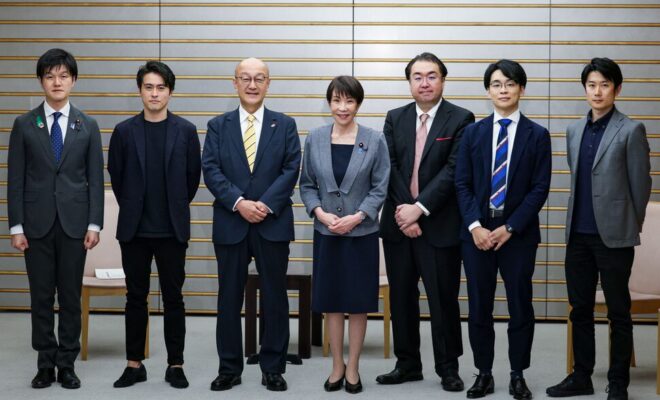
Prime Minister Sanae Takaichi met with five foodtech-related companies at the Prime Minister’s Office on April 23 to exchange views.
Participants included Oishii Farm, a vertical farming company that produces strawberries at scale in the United States; PlantX, another vertical farming company; FRD Japan, which develops land-based aquaculture; Regional Fish, which improves seafood varieties through gene editing; and Toko Tekko, which develops agricultural drones.
At the outset of the meeting, Prime Minister Takaichi said that Japan needs to achieve a strong economy while minimizing risks.
“If there is no demand, companies will not invest, conduct R&D, or produce. The government therefore wants to firmly open up demand both in Japan and overseas,” she said, expressing her intention to create demand for foodtech.
In November last year, the government announced 17 strategic fields, with “foodtech” designated as one of them.
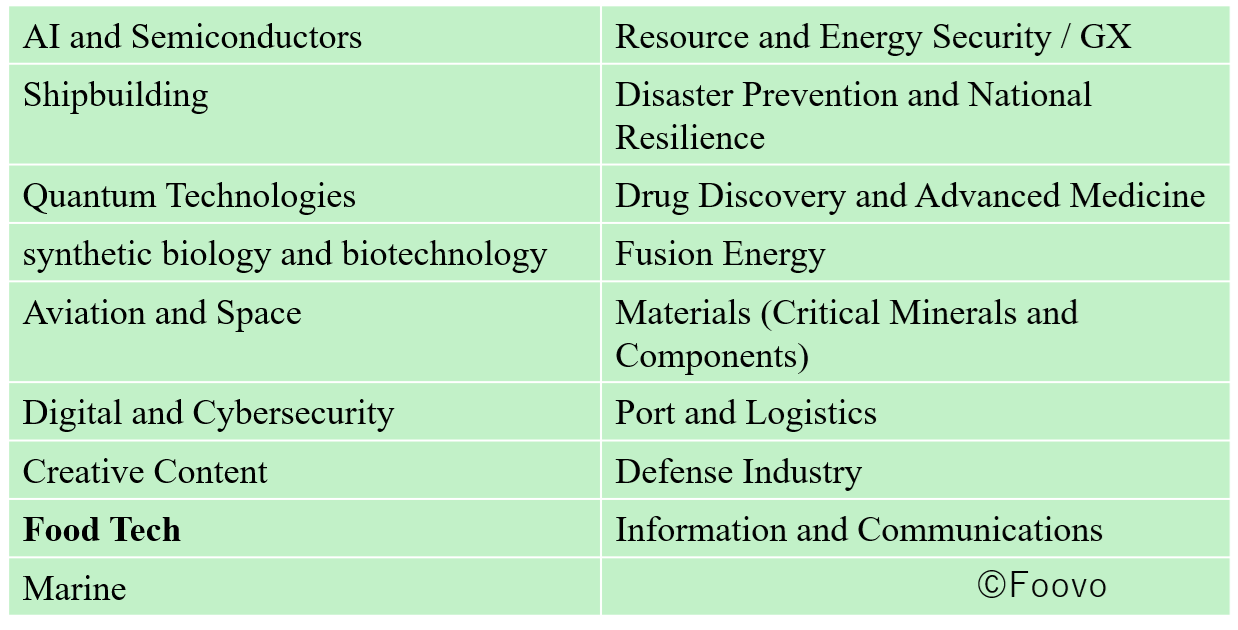
In December, the government finalized its review structure and established working groups for each field. These groups began discussions on the current situation, challenges, and future direction.
The Foodtech Working Group is examining a public-private investment roadmap for four areas: 1) vertical farming, 2) land-based aquaculture, 3) food machinery, and 4) new foods. The roadmap is intended to identify Japan’s areas of competitive advantage and cover investment priorities, target amounts, and timelines.
At the third meeting of the Japan Growth Strategy Council, held on March 10, the government organized the “key products and technologies” in the 17 strategic fields. In foodtech, vertical farming and land-based aquaculture were explicitly identified as the two areas among the four that would be considered first.
At the third meeting of the Foodtech Working Group, held on April 9, draft public-private investment roadmaps for the remaining two areas—food machinery and new foods—were also discussed. New foods include non-animal protein foods, as well as functional and nutritional foods.
Draft public-private investment roadmaps for all four areas are expected to be presented at the next, fourth meeting of the Foodtech Working Group.

On social media, Prime Minister Takaichi stated that Japan aims to promote exports and create “profitable agriculture, forestry, fisheries, and food industries” by also leveraging “world-class advanced technologies.”
Foodtech is a field linked not only to rising food demand and responses to climate change, but also to food security. Its scope is broad, covering areas such as plant-based, fungi-based, and cell-based alternative proteins; food robotics that can help address labor shortages; and vertical farms that are less vulnerable to the impacts of climate change.
At the fourth meeting of the Japan Growth Strategy Council, held on April 22, the government reiterated its intention to accelerate domestic investment by “thoroughly reinforcing domestic investment, which is overwhelmingly insufficient in Japan.” It said it would do so through “crisis-management investment” to minimize various risks and “growth investment” to help advanced technologies flourish.
This article is an English translation of a Foovo article originally published on April 27, 2026, and is published with permission from Foovo.
You may also LIKE: