
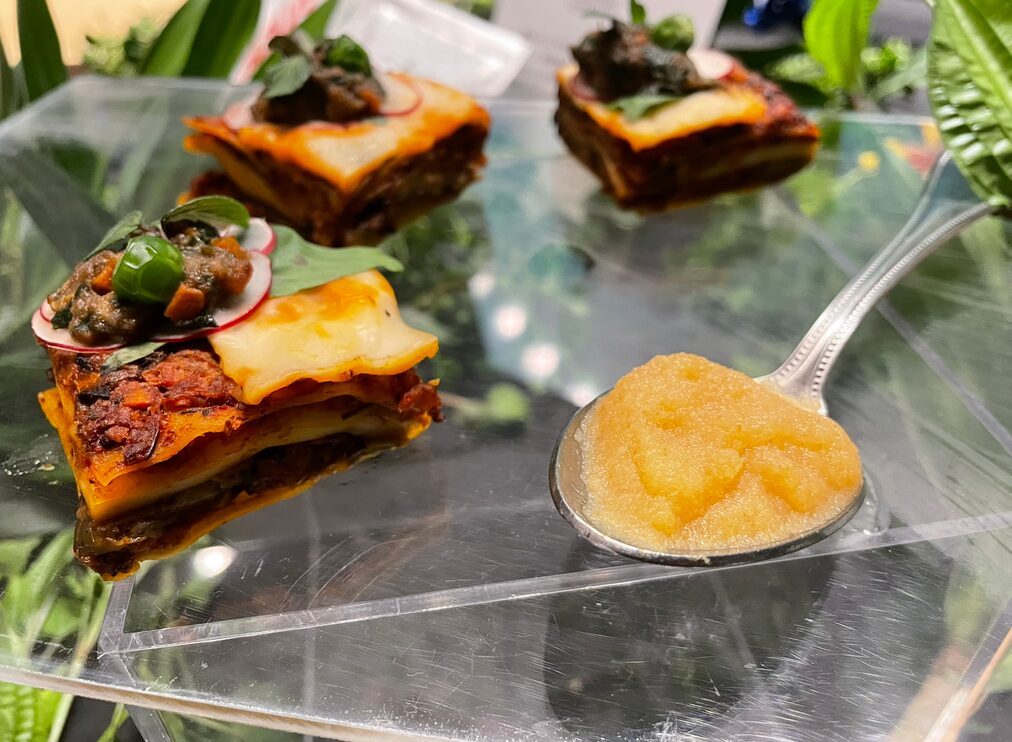
A prototype made from cultured duck cells by IntegriCulture and lasagna made using it. Photo by Foovo (Ayumi Sato)
Japan has presented draft text for most chapters of its first safety guidelines for foods produced using cell-culture technology, marking a significant step in the country’s regulatory discussions around cultivated meat.
The draft was presented on May 28 at a meeting of the Subcommittee on Newly Developed Foods under the Food Sanitation Standards Council.
While Japan has previously discussed safety considerations for cultivated meat, this is the first time that those discussions have been compiled into a concrete draft guideline.
The draft follows a series of deliberations held by Japan’s Ministry of Health, Labour and Welfare and the Consumer Affairs Agency. In total, the issue has been discussed 13 times: five times under the Ministry of Health, Labour and Welfare and eight times under the Consumer Affairs Agency’s subcommittee.
Until now, the discussions had focused on identifying safety concerns and hazards across three stages: cell sourcing, production processes, and food processing. Previous meetings had identified 31 points of concern and corresponding items to be checked.
The latest draft reorganizes these points into matters that businesses should confirm when ensuring the safety of cell-cultured foods. It covers areas including source cells and tissues, cell characterization, manufacturing and quality control, substances used during manufacturing and cultivation, final product specifications, and information related to allergens and nutrition.
One major topic on the meeting was how manufacturing and quality control should be positioned. The draft states that, because cell culture requires advanced control of living cells, not only contamination control measures based on general hygiene management and HACCP-like approaches, but also process control, including the management of cell growth, worker education and training, and the preparation of standard operating documents, are important (draft page4).
At a previous meeting in March, some industry participants had called for a framework based primarily on HACCP principles, arguing that the adoption of pharmaceutical GMP could create high barriers to entry. However, at the May 28 meeting, committee members raised concerns that HACCP alone should not be described as covering the full production process. Some suggested that the term “food GMP” should be considered instead.
Committee members also noted that the draft effectively calls for a GMP-like approach. Under GMP, manufacturing management and quality control are separated, creating a system of double checks within the production process.
The term “final product” also drew attention. In the draft, the final product is defined as the stage before the material is mixed with other ingredients or nutritionally supplemented. However, committee members pointed out that the term may be confusing because it generally suggests the product sold to consumers. They requested further clarification on whether it refers to the material recovered after cell culture, or to a stage after differentiation has been completed.
Regarding nutritional components, the draft states that while it would be difficult to assume that cell-cultured foods will completely match existing foods, it is desirable to consider comparisons with conventional foods and the presence or absence of substances that could interfere with nutrition.
This time, four consumer groups presented their views at the meeting, asking for safety reviews by the government, traceability, clear labeling, information disclosure by businesses, and communication with consumers.
Several groups argued that, at least in the early stage, Japan should adopt a review-based procedure in which the government checks each product individually. One group expressed concern that a simple notification system could lower barriers to entry and make it difficult to exclude businesses that do not sufficiently follow the guidelines.
They also called for labeling rules that clearly indicate when a food has been produced using cell-culture technology, so that consumers can distinguish it from conventional meat products and make informed choices.
Terminology was another unresolved issue. In Japan, different terms are currently used in different policy discussions, including “cultivated meat”, “cell cultured foods” and “cell-based foods.” Committee members warned that inconsistent terminology across definitions, labeling, and guidelines could cause confusion, especially if imported products enter the market before a common term is established.
The May 28 meeting therefore went beyond the technical content of the draft guidelines. It also addressed broader questions around safety procedures, labeling, terminology, and consumer communication.
The subcommittee is expected to continue refining the draft guidelines based on the latest discussions.
This article is an English summary of Foovo’s Japanese-language report, which was written based on Foovo’s attendance at the May 28 meeting. It is republished on FoovoBridge with Foovo’s permission.