
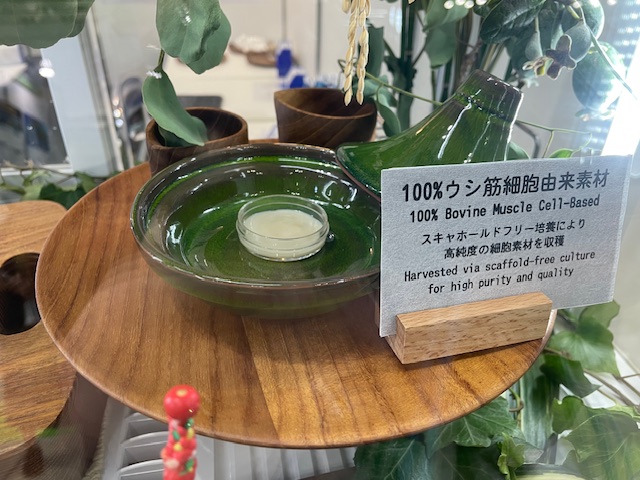
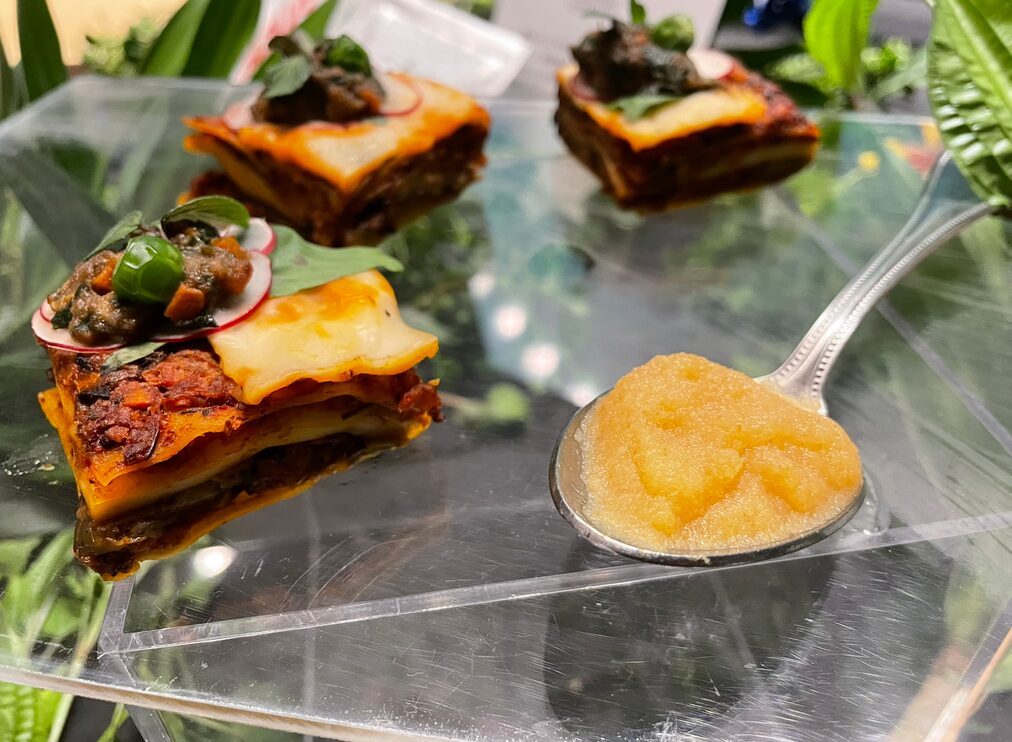
The company’s cell-based beef exhibited at Bio Japan 2025. Photo by Ayumi Sato (Foovo)
Organoid Farm, a company developing cultivated beef, announced on the 17th that it had conducted a demonstration cultivation trial for culturing bovine muscle cells using a 200-liter bioreactor.
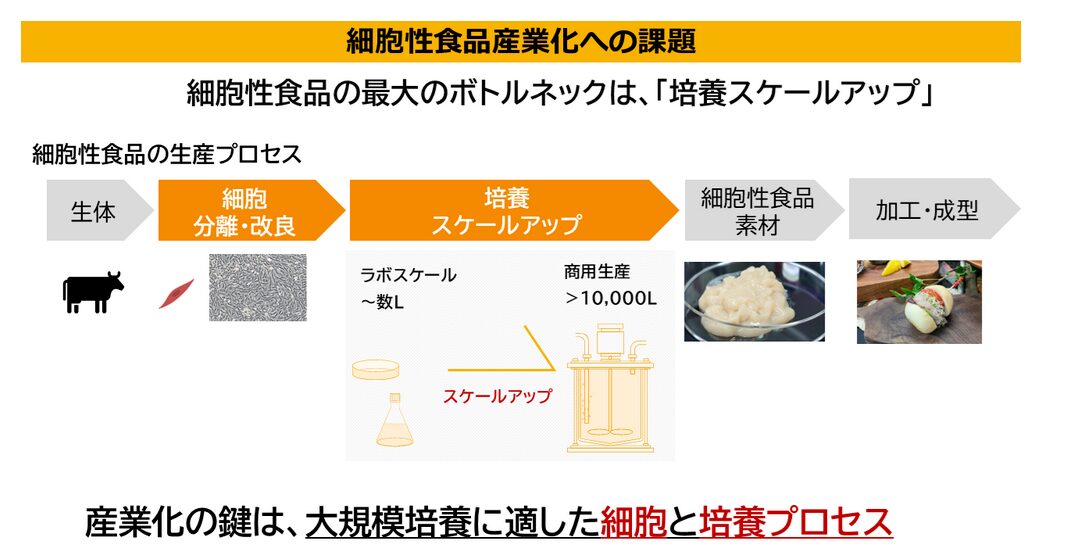
According to the company, the demonstration is among the largest in Japan for cell-cultured food at the 200-liter scale. By completing the entire process from cultivation to harvesting, the company said it has established a technological foundation for scale-up and cost reduction toward commercial production.
Successful 200L Demonstration Cultivation of Bovine Muscle Cells
For this demonstration, the company utilized a bioreactor for animal cells owned by JGC Holdings’ Technical Research Institute and a bovine muscle cell line known to be difficult to culture. The cultivation process employed suspension culture without the use of scaffolding materials.
According to the press release, eliminating the use of scaffolding materials is expected to reduce raw material costs and simplify the recovery process. Since it allows for a simpler culture environment, it leads to uniform mixing and stable cultivation. Additionally, operational efficiencies are anticipated in areas such as equipment cleaning and sterilization.
The cell line used was developed and patented by Organoid Farm. Unlike typical bovine muscle cells, these cells are characterized by their ability to continue proliferating without easily stopping cell division midway.
The company conducted the cultivation from January to February 2026, and successfully obtained proliferated bovine muscle cells in the initial trial. This announcement demonstrates that the company is steadily advancing preparations for scale-up in both the cell line and culture process.
Organoid Farm was established in 2021 as a group company of JGC Holdings. The company has advanced its research and development by combining its proprietary cell lines and culture technologies with the JGC Group’s expertise in scale-up and engineering cultivated in the pharmaceutical and regenerative medicine fields.
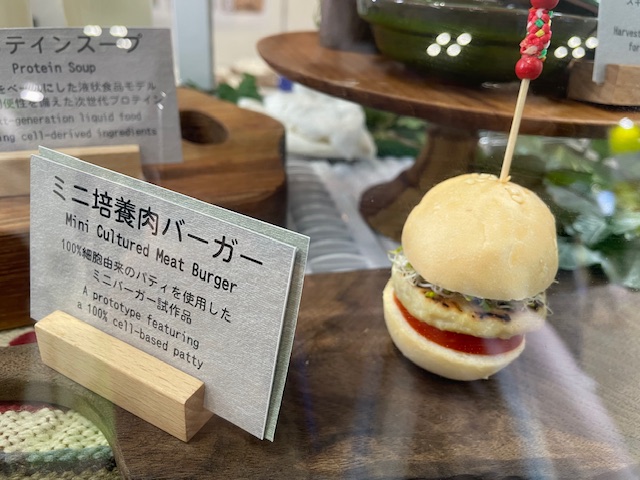
Last year, the company began selling Wagyu cells to corporations and research institutions. At last year’s Bio Japan, it unveiled several prototypes, including raw cellular beef consisting entirely of cells and mini-burgers made from it.
Going forward, the company plans to proceed with verifying cultivation efficiency while also establishing demonstration sites for practical application and exploring collaborations with strategic partners. In 2028, the company plans to open a new facility to accelerate scale-up demonstration tests and prototype development for commercial production.
Progress in Regulatory Framework and Commercialization in Japan
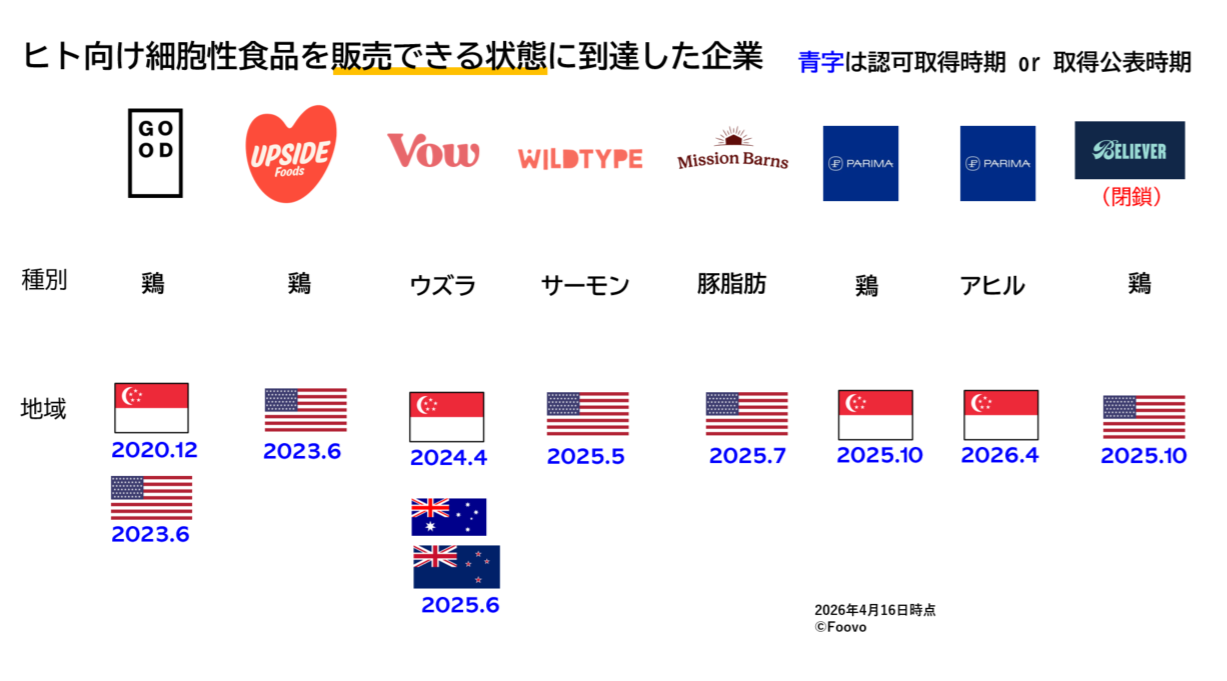
Globally, cases of cell-based food sales have emerged in Singapore, the United States, Australia, and Hong Kong; if pet food is included, there are also sales cases in the United Kingdom and Australia.
Meanwhile, in Japan, regulatory frameworks are still under development and sales have not yet been realized; however, discussions are underway within the Consumer Affairs Agency’s Subcommittee on Newly Developed Foods to establish guidelines for cell-based foods.
Movements aimed at commercialization are also gaining momentum.
IntegriCulture, which achieved profitability last year, signed a joint development agreement in January of this year with Oisix Ra Daichi, which is advancing the Niigata Food Tech Town initiative with the aim of creating cell-based foods that tell local stories.
In materials dated March 30, 2026 submitted to the subcommittee, the company stated that it is proceeding with stable manufacturing trials and data collection on a schedule that aims for a market launch on April 1, 2027.
Diverse Farm, which is developing cell-based chicken, is planning to expand its manufacturing technology through B2B partnerships in Singapore, Australia, and other regions to accelerate commercialization.
French company PARIMA, which has obtained approval for two animal species in Singapore, also indicated in its submission deck to the Research Committee that it plans to begin domestic manufacturing in Japan as soon as a market launch becomes possible.
Furthermore, Ajinomoto announced this month the development of a new technology involving plant-derived ingredients capable of maintaining high growth rates in serum-free culture media, intended for supply to cell-based food companies.
This article is an English translation of a Foovo article originally published on April 20, 2026, and is published with permission from Foovo.
You may also LIKE:
Integriculture and Oisix ra daichi Partner to Joint Develop Niigata-Branded Cell-Based Foods